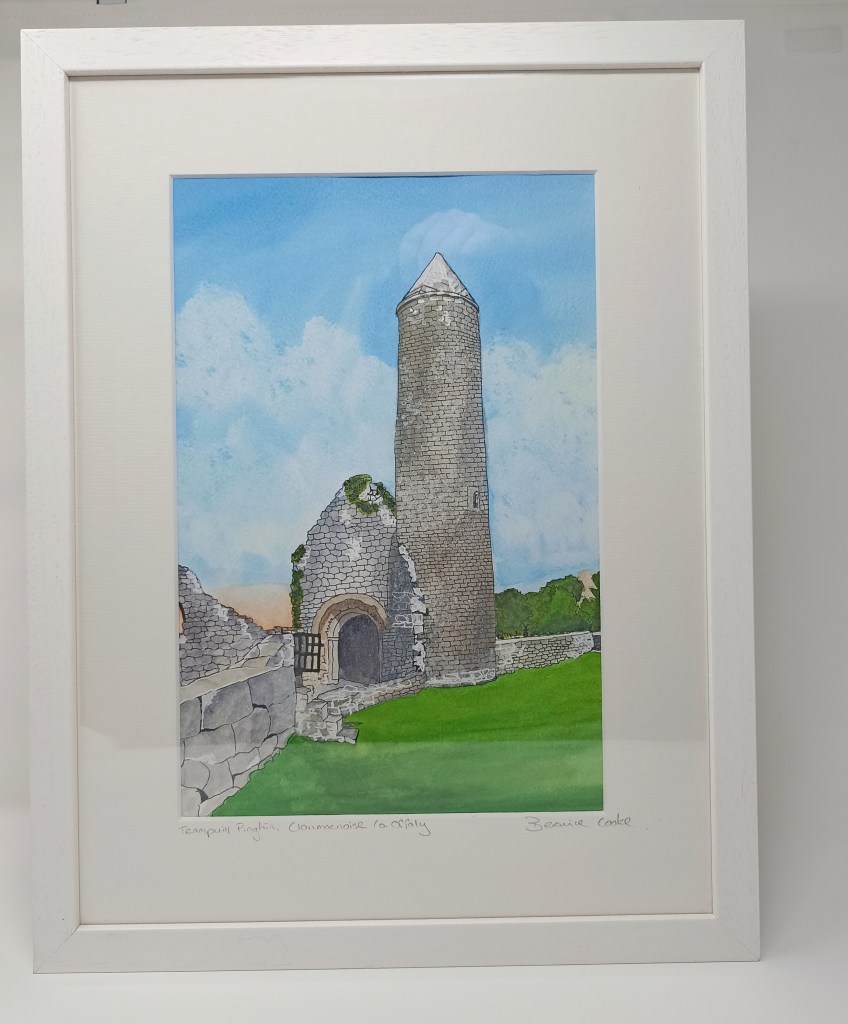
Nestled on the banks of the River Shannon, just outside Shannonbridge, County Offaly, lies one of Ireland’s most important monastic sites – Clonmacnoise. Founded in 544 AD by St. Ciarán of Roscommon, this remarkable settlement grew into a hub of religion, education, craftsmanship, and political power, earning it the title Ciarán’s Shining City. Today, its evocative ruins tell the story of Ireland’s Golden Age of Christianity.
The Origins of Clonmacnoise
St. Ciarán, son of a humble craftsman from Rathcroghan in County Roscommon, stood out for his intelligence and holiness. After establishing a small monastery on Hare Island in Lough Ree, he chose Clonmacnoise as the site of his next settlement. Its location was no accident – it sat at the crossroads of two medieval powerhouses, Connacht to the west and Míde (Meath) to the east, with access via the River Shannon and the ancient Esker Riada road, a natural ridge left behind after the Ice Age.
When Ciarán arrived at Clonmacnoise in 544, he encountered Diarmait mac Cerbaill, who would later become the first Christian-crowned King of Ireland. Together they built the first church, a timber structure. Sadly, Ciarán died only a few years later, aged 33, likely from plague. He is believed to have been buried beneath that wooden church, now the site of the 9th-century Temple Ciarán.
A Centre of Learning, Power, and Conflict
From the 9th to 11th centuries, Clonmacnoise flourished under alliances with the Kings of Meath. It became one of Europe’s leading centres of religion and scholarship, attracting monks, artisans, and pilgrims. Many High Kings of Tara and Connacht are buried here, cementing its status as a sacred resting place.
But its prestige also sparked rivalries. In AD 764, a bloody battle broke out between Clonmacnoise and St. Columba’s monastery at Durrow, leaving 200 men dead. Despite its reputation as a holy site, Clonmacnoise was also a political powerhouse, raided repeatedly by rival kingdoms and Vikings in the 9th century.
The community thrived within its three enclosures, inspired by biblical descriptions of Jerusalem:
- Santissmus – open only to priests
- Sanctior – open to those deemed virtuous
- Sanctus – open even to sinners
The lay population included farmers, masons, metalworkers, and carpenters – all contributing to its prosperity.
Decline and Destruction
Clonmacnoise’s fortunes declined after the Norman invasions, as rival towns like Athlone grew in importance. New religious orders such as the Cistercians and Franciscans competed for followers, while Viking raids and English attacks weakened the site.
In 1552, the English garrison at Athlone delivered the final blow, plundering and destroying Clonmacnoise. What remains today are haunting ruins that hint at its former glory: a cathedral, seven churches, two round towers, three high crosses, and over 700 early Christian grave slabs.
Highlights of Clonmacnoise
The Cathedral
Built in AD 909 by King Flann Sinna, the Cathedral is Ireland’s largest pre-Romanesque church. Its famous “Whispering Arch” doorway, added in the 15th century, features carvings of Saints Dominic, Patrick, and Francis. It is also the burial site of Tairrdelbach Ua Conchobair (King of Connacht) and his son Ruaidrí Ua Conchobair, the last High King of Ireland.
Temples of Clonmacnoise
- Temple Ciarán – Believed to house St. Ciarán’s remains, a rare Early Irish Shrine Chapel.
- Temple Dowling / Temple Hurpan – A 10th-century church extended in 1689.
- Temple Melaghlin (Teampall na Rí) – The Church of Kings, burial place of Connacht rulers.
- Temple Conor – Resting place of the O’Connor dynasty, now reroofed as a Church of Ireland chapel.
- Temple Kelly – Ruins associated with the O’Kelly clan.
The Round Towers
Two round towers stand at Clonmacnoise:
- The Northwest Tower, built in 1124, once soared higher before lightning damage in 1135.
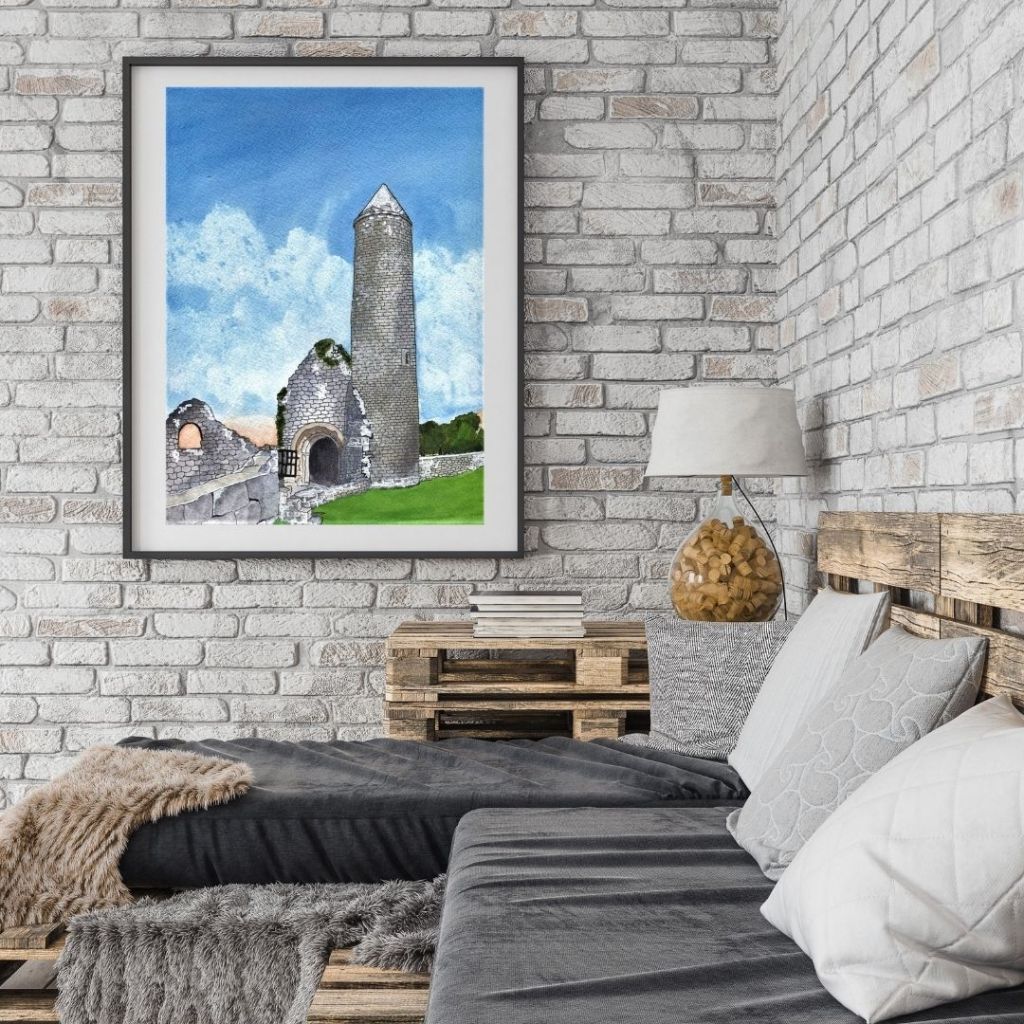
- The Tower of Teampall Finghín, integrated into the church itself, a rare architectural feature inspired by Cormac’s Chapel at the Rock of Cashel.
The High Crosses
- Cross of the Scriptures – One of Ireland’s finest high crosses, with carvings of Christ’s crucifixion and resurrection.
- South Cross – A transitional piece with abstract designs and a crucifixion scene.
- North Cross – The earliest, though only its decorated shaft remains.
Originals of all three are preserved in the Visitor Centre, with replicas displayed outdoors.
The Nun’s Church
Built in AD 1167 for Derbforgaill, daughter of the King of Meath, the Nun’s Church is a stunning example of Hiberno-Romanesque architecture. Its carvings of serpents, plants, animals, and the enigmatic Sheela na Gig are among Ireland’s finest.
Clonmacnoise Castle
Outside the monastery stands a Norman castle, built in 1214 to control River Shannon traffic. It was abandoned by the 14th century, but its remains still guard the landscape.
Visiting Clonmacnoise Today
Walking through Clonmacnoise is like stepping back in time. The site may be in ruins, but its cathedral, churches, towers, and crosses whisper stories of saints, kings, and scholars who shaped Irish history.
For anyone exploring Ireland’s Ancient East or journeying along the River Shannon, a visit to Clonmacnoise, County Offaly, is an unforgettable experience – a place where spirituality, history, and landscape converge.
 Bernice Cooke Artist
Leave a comment