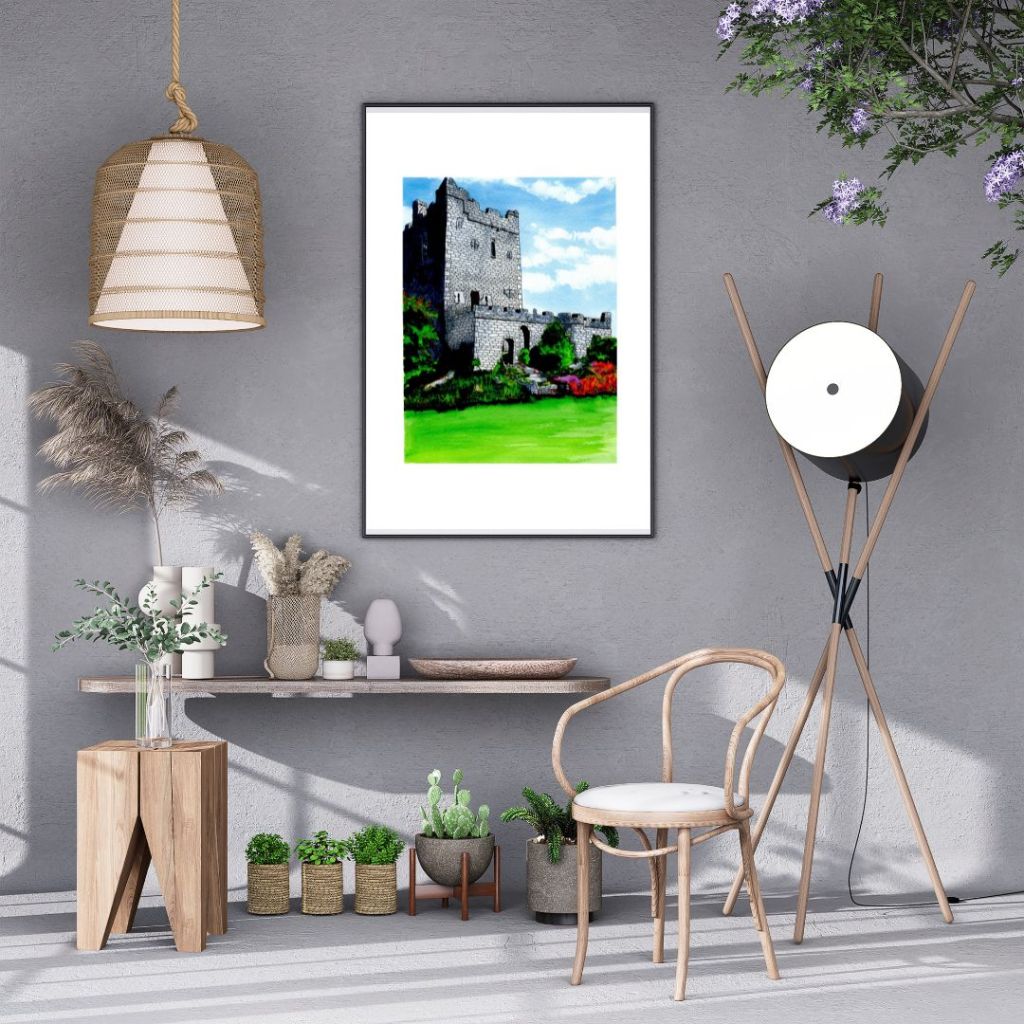
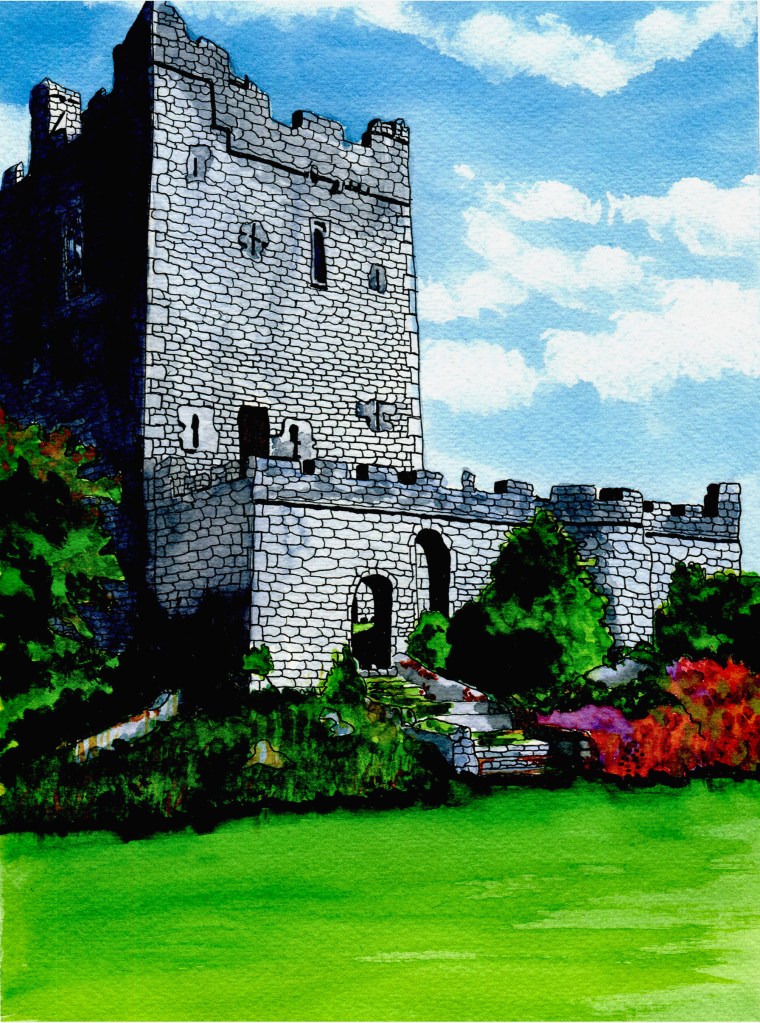
Nestled between the River Brosna and the Grand Canal, the tiny village of Clonony, County Offaly, holds one of Ireland’s best-kept historical secrets — Clonony Castle. Just one mile west of Cloghan and four miles east of Banagher, this striking Tudor-style tower house stands as a testament to Ireland’s turbulent past and its surprising links to English royalty.
A Tower House Built by the MacCoughlan Clan
Clonony Castle was built in the early 1500s by the MacCoughlan family, one of the most prominent Gaelic clans of the time. A perfect example of an Irish Tower House, it rises 15 metres (about 50 feet) high and is surrounded by the remnants of a bawn wall, formal entrance, and smaller defensive towers. Within the grounds, the ruins of an old church can still be found — a haunting reminder of centuries past.
The castle retains many distinctive medieval features, including a murder hole, base batter, mural passages, spiral staircases, gun loops, and a variety of window styles — from round-headed and ogee-headed to flat-headed designs. You’ll even find medieval garderobes (toilets built into the walls) — an authentic touch of the 16th century!
The First Place in Ireland to Fire Muskets
Few know that Clonony Castle was reportedly the first place in Ireland where muskets were fired — a remarkable historical footnote that adds to its unique legacy.
15″ x 18″ inches
€480
The Boleyn Connection: From Tudor Intrigue to Irish Refuge
Clonony Castle’s story takes an unexpected royal turn during the reign of Henry VIII. The castle was surrendered to the English crown by John Óg MacCoughlan, who then gifted it to Thomas Boleyn, father of Anne Boleyn, the ill-fated second wife of Henry VIII.
When Anne Boleyn rose to prominence, her father was granted the title Earl of Ormond, elevating her status to Countess, and making her a more suitable match for the King of England.
But history turned dark. After Anne’s tragic execution, members of her family sought refuge in Ireland — some finding safety behind the thick walls of Clonony Castle.
The Boleyn Tomb at Clonony Castle
Two of Anne Boleyn’s cousins, Elizabeth and Mary Bullyn, lived and died at Clonony Castle. Their tombstone, discovered in 1803 about 100 yards from the castle under a hawthorn tree, measures an impressive eight by four feet. Its inscription records their lineage, linking them directly to the Boleyn family and Queen Elizabeth I:
“Here under leys Elisabeth and Mary Bullyn daughters of Thomas Bullyn, son of George Bullyn the son of George Bullyn Viscount Rochford son of Sir Thomas Bullyn Earl of Ormond and Willsheere.”
This gravestone remains one of Ireland’s most fascinating Tudor-era relics.
Mathew de Renzi and the First English-Irish Dictionary
Between 1612 and 1620, the castle was home to Mathew de Renzi, a London cloth merchant originally from Germany. According to his headstone, he is credited with creating the first English-Irish dictionary, further adding to the castle’s remarkable legacy as a crossroads of culture, commerce, and language.
A Modern Revival — and a Ghostly Resident
Though parts of the structure had fallen into ruin over time, Clonony Castle was lovingly restored by an American ballerina in recent years. As of March last year, the property was once again placed on the market, offering a rare opportunity to own a slice of Tudor and Irish history.
But Clonony’s story doesn’t end there. Local lore tells of a tall, thin man in medieval attire seen walking atop the three-storey tower — the ghost of Clonony Castle. Whether it’s the spirit of a long-dead soldier or one of the Boleyn cousins watching over their Irish refuge, visitors still wonder: is it fact or folklore?
Visit Clonony Castle, County Offaly
If you’re exploring Ireland’s hidden historical sites, Clonony Castle in County Offaly is a fascinating stop — even if it can only be admired from the roadside. Privately owned and recently listed for sale, this Tudor-era Tower House stands as a beautifully preserved reminder of Ireland’s medieval past.
With its striking stone structure, rich Tudor connections, and haunting legends linking it to Anne Boleyn, Clonony Castle offers a rare glimpse into a time when Irish and English histories were deeply intertwined.
While visitors cannot currently enter the castle, its dramatic silhouette rising above the surrounding landscape makes it a worthwhile stop for history enthusiasts, photographers, and anyone intrigued by haunted Irish castles or Offaly’s hidden heritage.
 Bernice Cooke Artist
Leave a comment