A Journey Through Time, Nature, and Controversy
Situated off the N52 and just some five miles from the bustling town of Tullamore, in County Offaly.
A point to note is that there is also a town in County Laois named Durrow, not the same place as the location above.
Durrow originally called under its Irish name Daru meaning plain of oaks the abbey is surrounded by beautiful woods of an old woodland estate. A place where you will find some of the only remaining pre – mediaeval oaks in Ireland. You will also find Scots Pine, Norway Spruce, Birch and Rowan swaying to the beat of the Irish seasons.
This place is a large ecclesiastical enclosure with five Early Christian grave slabs, a mid 9th century High Cross and a holy well all feature in this location.
St. Columba’s Church of Ireland located on the monastic site houses some of these artefacts.
Hugh deLacey Lord Of Meath built a Motte and Bailey for the Abbey in 1180 he was later killed at the Abbey in 1186.
Not much is known about the early history of Durrow. It may have been founded by Columba in 580. Durrow was a favourite of Clan Cholmáin and in 763 Domnall Midi was buried there. In 764 Durrow appeared in the Annals when they went to battle with the people of Clonmacnoise as part of the Clann Cholmáin succession struggle.
During Columba’s life Durrow was a place of learning and education. At a later stage Durrow was called one of the universities of the West. Like most of the other monasteries in the surrounding areas Durrow was pillaged and raided by Vikings, but it was not completely destroyed until the Norman Invasion. Now there is nothing left of this once vibrant Abbey.
The famous illuminated manuscript Book of Durrow, now housed in Trinity College Dublin, was at the Abbey until about 916. Found in the hands of a local farmer the book is one of the earliest surviving fully decorated Insular Gospel Books, believed to be dated from the 7th or 8th century.
The line of oak trees that is located beside this monastic site also marks the route of the Slighe Mór or Great Highway along the Esker Riada. The area is Mag Lena where a synod of Irish Clerics was held in AD630 to resolve the controversy over the date of Easter.
In the Annals of the Four Masters July of 1054 Monks in Durrow Abbey observed a bright star that appeared overnight. Their recorded sighting is the only known European sighting of the Supernova of 1054.
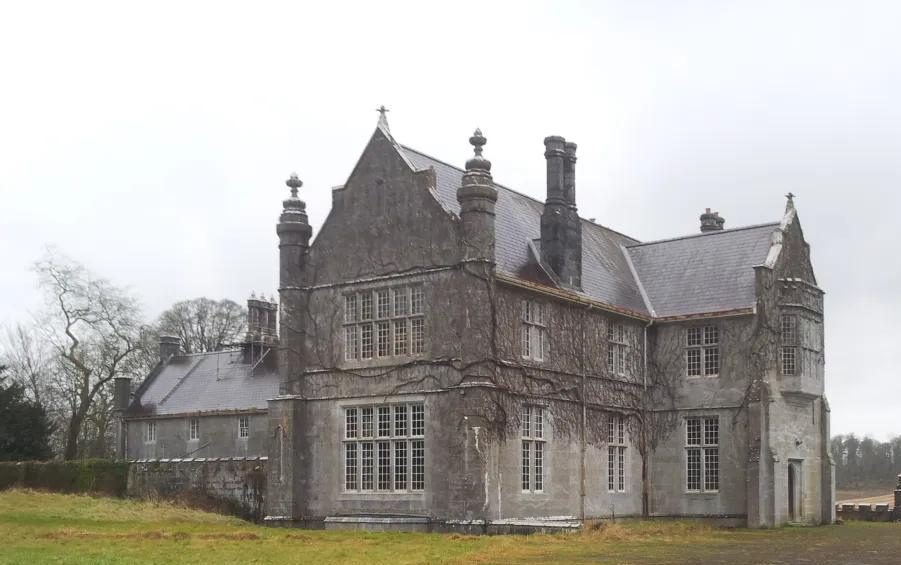
Located near the monastic site is Durrow Abbey House, it has featured a lot in the media over the past few years due to a dispute between the OPW and a charity that has leased the premises.
The Story of Durrow Abbey House involves two fires. One fire broke out in 1843 when the house was under construction destroying the adjacent Georgian Mansion and all its furnishings and fittings. The other fire in 1923 after the Irish Civil War meant the house was completely destroyed. Ralph H. Byrne was commissioned by Ottoway Graham Toler in 1926 to oversee the reconstruction of the house. All that had remained of the previous house after the fire in 1923 was the exterior walls. A complete redesign was undertaken. Several designs were produced including an Arts and Crafts design and a Tudor Gothic in keeping with the previous house design. The new house was storey lower whilst utilising the floor plans of the old house.
So what went on behind the scenes of this monastic site, with its Church and House?
In 1992 plans were approved by Offaly County Council for the then current owners to develop a golf course, hotel, self catering chalets, and an air strip. The planning permission expired and the plans did not go ahead.
In the year 1994 the Church of Ireland handed over St. Columba’s Church to the State after a dispute about ownership.
In 1998 the then owners began negotiations with the Lowes of Durrow Abbey Trust to sell the estate for 2 million. The Lowes are descendants of St. Columba, this deal fell through and nothing went ahead.
In the year 2000 planning permission was once again applied for to develop the site but it was denied on the grounds of lack of archeological information presented with the plan.
In 2003 the Irish Government bought Durrow Abbey House, and its monastic surrounds for the sum of 3.175 million. This was a move to protect the buildings and any further developments that would damage this historic site.
And then it all went downhill from there at a rapid pace.
In May 2007 a 99 year full repair and insure lease on Durrow Abbey House was agreed upon by the then Minister for the Environment and Heritage and The Arts for Peace Foundation. This agreement required the lessee – The Arts for Peace Foundation to carry out all internal and external repairs and maintenance on the house.
In 2016 The Arts for Peace Foundation sued the OPW for breach of contract alleging a lack of maintenance of Durrow Abbey House.
The charity had not used the house since 2013 because of the dispute over repairs. In 2015 Minister of State at the Department of Public Expenditure and Reform stated that the lease included an obligation on the tenant to insure upkeep on the house and estate and that they as tenants failed to keep their side of the agreement.
Meetings were then held in 2018 with plans to surrender the lease of Durrow Abbey House back to the state for a sum of €600,000.
In May 2021 the House was finally repossessed by the OPW in a press statement it was said the OPW were on “sound legal ground” based on the lease agreements not being honoured by the Arts for Peace Foundation. The Arguments continue whilst the building lies idle.


Leave a comment